

Money decisions feel personal because they shape our future. I still remember the first time I faced this question myself: should I keep my money safe in a Fixed Deposit or start investing through SIP? Like most, I wanted safety, growth, and peace of mind at the same time. That confusion is exactly why this article exists. In this detailed guide, we will clearly understand SIP vs FD from basic to intermediate and finally to an advanced level.

This is not advice. This is awareness so you can choose what truly fits your life in 2026
SIP vs Fixed Deposit explained: Learn returns, risk, tax impact, and where to invest wisely in 2026.
What Is a Fixed Deposit?
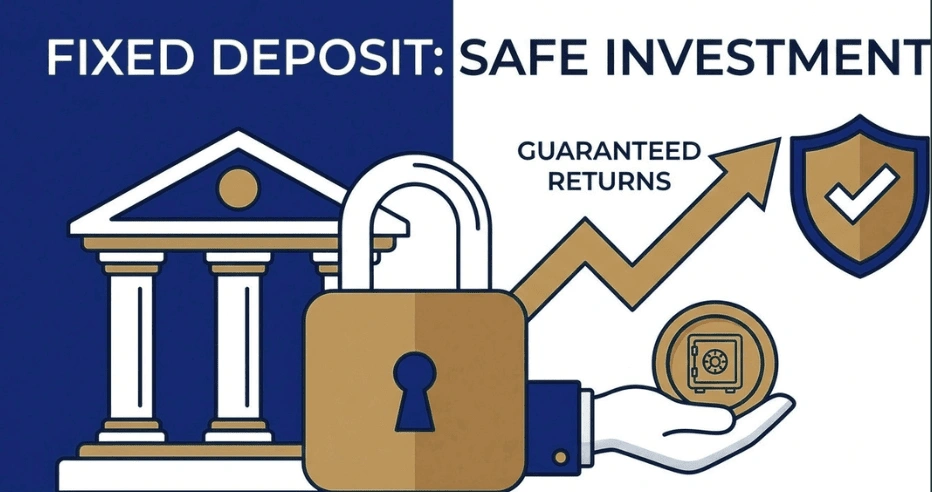
A Fixed Deposit, commonly called an FD, is one of the most trusted investment options in India. You deposit a lump sum with a bank or financial institution for a fixed period and earn guaranteed interest.
People love FDs because they feel safe, predictable, and simple. You know exactly how much money you will get at maturity.
Key features of Fixed Deposits:
- Capital protection
- Fixed returns
- Low risk
- Suitable for conservative investors
How Fixed Deposits Work
Banks offer Fixed Deposits for durations ranging from a few months to several years. Interest rates may vary based on tenure and institution.
Senior citizens often receive higher interest rates. However, inflation can quietly reduce the real value of FD returns.
What Is SIP?

SIP stands for Systematic Investment Plan. It allows you to invest a fixed amount into mutual funds, usually monthly.
Instead of investing a large sum at once, SIP encourages discipline and consistency. It helps investors participate in the market without worrying about timing.
Key features of SIP:
- Market-linked returns
- Long-term wealth creation
- Rupee cost averaging
- Flexible investment amount
How SIP Works for Indian Investors
When you invest through SIP, your money is allocated into mutual funds that invest in equity, debt, or a mix of both. Over time, market ups and downs average out.
This makes SIP ideal for salaried individuals and long-term planners.
SIP vs FD Core Difference
TheThe real difference between SIP and Fixed Deposit lies in risk and growth potential.
- Fixed Deposit prioritizes safety.
- SIP focuses on growth
Both serve different financial purposes.
Returns Comparison SIP vs Fixed Deposit
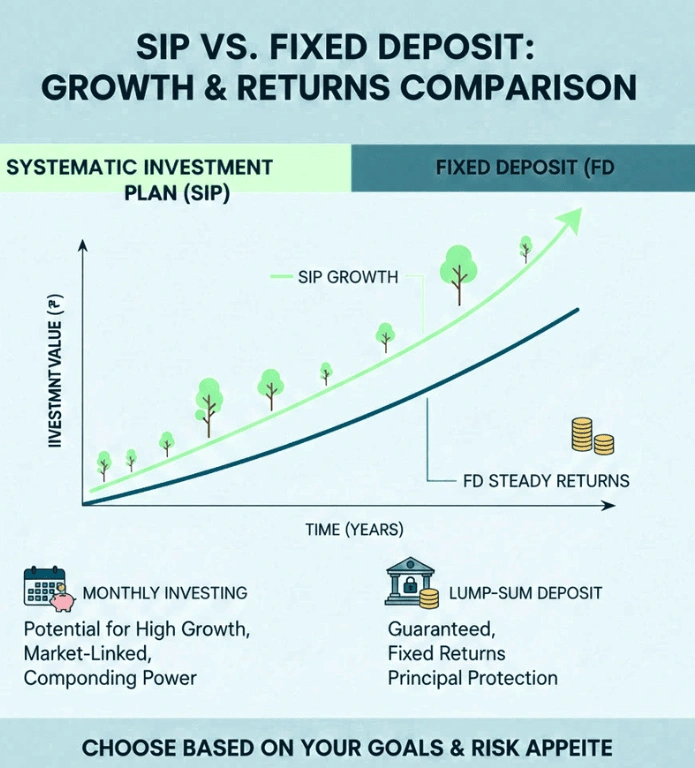
Fixed Deposits offer stable but limited returns.
SIP returns depend on market performance. Over long periods, SIPs have historically delivered higher returns than FDs, but without guarantees.
Returns should always be viewed along with risk.
Risk Factor Explained Simply
FD risk is low but not zero. Inflation risk exists.
SIP carries market risk. Short-term volatility is common.
Risk tolerance decides suitability.
SIP vs FD and Inflation
Inflation slowly eats savings.
FD returns often struggle to beat inflation.
Equity-based SIPs have better potential to protect purchasing power over time.
Taxation Difference Between SIP and FD
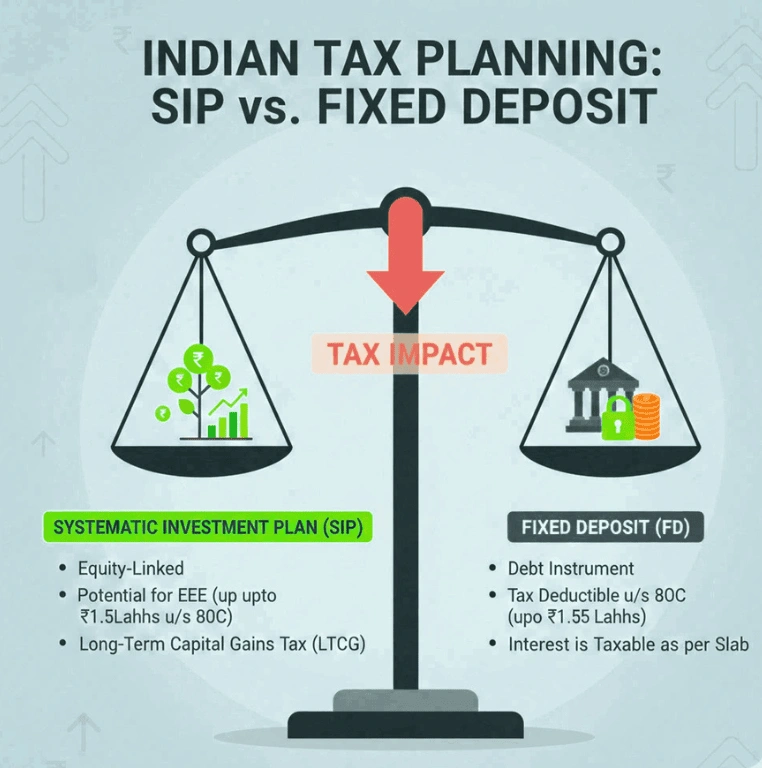
Interest from Fixed Deposits is fully taxable based on your income slab.
SIP taxation depends on fund type and holding period. Long-term investments enjoy tax efficiency.
Tax planning plays a major role in final returns.
Liquidity and Flexibility
FDs usually have long tenures and penalties on early withdrawal.
SIPs offer better flexibility. You can pause, increase, or stop investments at your own ease.
Who Should Choose Fixed Deposit?
FDs are suitable for:
- Risk-averse individuals
- Retirees
- Short-term goals
- Emergency funds
Safety matters more than growth here.
Who Should Choose SIP?
SIPs are suitable for:
- Long-term investors
- Young earners
- Wealth builders
- Inflation-conscious savers
Time becomes your biggest advantage.
SIP vs FD for Different Life Stages
Earlier investors benefit more from SIP.
Middle-aged investors can balance both.
Retirees may prefer FDs with selective SIP exposure.
Psychological Comfort Matters
FD gives mental peace.
SIP tests patience during market corrections.
Understanding your emotions is important.
SIP vs FD in 2026
In 2026, rising awareness, digital platforms, and inflationary pressures make SIPs more attractive for long-term goals.
FDs remain important for stability and safety.
A combination often works best.
Using Smart Strategy
Using Smart Strategy, there is no need to compare SIP vs FD.
Instead of choosing one, many People use both.
FD for safety.
SIP for growth.
Balance creates stability.
Common Mistakes People Make
- Chasing returns blindly
- Ignoring inflation
- Investing emotionally
- Not reviewing goals
Education reduces mistakes.
Learn more about Mistakes that destroy your wealth.

Final Verdict
The debate of SIP vs FD is not about which is better for everyone. It is about what is better for you.
FD gives certainty.
SIP builds wealth.
In 2026, in today’s Era, informed decisions matter more than ever.
FAQs
1. Is SIP safer than Fixed Deposit?
FD is safer. SIP offers higher growth potential with risk.
2. Can SIP guarantee returns?
No. SIP returns depend on market performance.
3. Is FD good for long term wealth?
FD is better for capital protection than wealth creation
4. Can I invest in both SIP and FD?
Yes. A balanced approach works well for many Indians.