

You understand what an IPO is. Now comes the harder part: deciding whether to invest, figuring out where to apply, and knowing what separates a genuinely sound company from one riding pure hype. This guide walks through all three — the mechanics of applying, and more importantly, how to actually evaluate an IPO before you commit any money to it.
Where Do You Actually Invest in an IPOs?

This confuses more beginners than anything else: you don’t buy IPO shares the same way you buy a regular stock.
- Primary market — this is where IPOs happen. You’re not buying from another investor; you’re applying directly for newly (or existing) issued shares before the stock exists on the open market.
- Secondary market — this is the regular stock exchange (NSE/BSE, NYSE/NASDAQ, etc.), where shares trade freely after listing. If you miss the IPO or don’t get allotted shares, this is where you can still buy in — just at whatever price the market has set.
Applying for an IPO means submitting a bid through your broker or bank; it doesn’t guarantee you’ll receive shares. Allotment depends on demand.
What You Need Before You Can Apply in IPOs
- A Demat account — where your shares will be electronically held once allotted.
- A trading account — usually opened together with your Demat account through a broker.
- A PAN card (India) or equivalent tax ID — mandatory for any financial application.
- A bank account linked to UPI or net banking — this is where your application money gets blocked (not spent) until allotment.
Regional note: The steps below describe India’s current process. In the US, IPO access for retail investors works very differently — shares get allocated by brokerages to select clients rather than through an open bidding system most retail investors can access. The underlying idea — applying before listing, with no guarantee of allotment — is universal; the mechanics are not.
Step by Step How to Apply for an IPOs

- Read the prospectus first — before applying anywhere, read at least the summary and risk factors in the company’s RHP/DRHP.
- Open your broker’s app (or your bank’s net banking portal) and go to the IPO section.
- Select the IPO you want to apply for and enter your bid — the number of lots, and ideally the “cut-off price” option, which slightly improves your allotment odds as a retail investor.
- Enter your UPI ID and submit the application. For applications above ₹2 lakh, or if you prefer not to use UPI, you can apply via ASBA (Application Supported by Blocked Amount) through net banking instead.
- Approve the UPI mandate request that lands in your UPI app — this must be done before 5:00 PM on the IPO’s closing day. Miss this deadline and your application is automatically rejected, no exceptions.
- Your money is blocked, not deducted — it stays in your account (and typically still earns interest) until allotment is finalized. If you don’t get allotted shares, the blocked funds are released easily.
- Check allotment status — typically finalized one working day after the IPO closes (T+1).
- Shares are credited and the stock lists shortly after — under the current shortened cycle, this generally happens within about three working days of the IPO closing (T+3).
One rule that trips people up: you can only submit one application per PAN per IPO. Using Multiple applications across different brokers with the same PAN gets all of them rejected, not just the extras.
How to Actually Analyze a Company Before their IPOs

This is the part most beginners skip — and it’s the part that actually matters. Anyone can click “Apply.” Knowing whether you should is the real skill.
1. Read the Prospectus — Specifically These Sections
The RHP (Red Herring Prospectus) is long, but you don’t need to read it all. Prioritize:
- Risk Factors — companies are legally required to disclose real risks here. Read this before any marketing material.
- Objects of the Issue / Use of Proceeds — where exactly is the money going?
- Financial Statements — at least 3 years of revenue, profit, and debt.
- Promoter and management background — any past litigation, regulatory action, or governance red flags.
2. Check Revenue Growth, But Look for Consistency, Not Just Size
Suppose a company is growing from a revenue by 10% steadily for 3 years is a very different comparatively from the one that jumped 200% in the final year right before the IPO. Sudden pre-IPOs spikes deserve extra scrutiny.
3. Check Actual Profitability, Not Just Revenue
Revenue tells you the company is selling something. Profit (and profit margin) tells you whether it’s selling it sustainably. A company with high revenue but a razor-thin or negative margin is a fundamentally different investment than one with steady, healthy margins — even if both have “growth” headlines.
4. Look at Debt Levels
A high debt-to-equity ratio, especially combined with weak profitability, means a larger share of future earnings goes towards interest payments rather than growth or dividends.
5. Compare Valuation to Listed Peers
If similar, already-listed companies in the same industry trade at a certain P/E ratio, and the IPO is priced well above that, ask why. Sometimes there’s a good reason (faster growth, better margins); sometimes it’s just aggressive pricing designed to maximize what promoters and early investors get on the way out.
6. Check How Much of the IPOs are Fresh Issue vs OFS
- Fresh Issue — money goes into the company for growth, debt repayment, or expansion.
- Offer for Sale (OFS) — money goes to existing shareholders exiting.
An IPO that’s almost entirely OFS with little-to-no fresh issue means very little new capital is actually reaching the business — it’s largely an exit event for early investors and promoters.
7. Check Promoter Shareholding Before and After
A significant drop in promoter holding post-IPO isn’t automatically bad, but it’s worth understanding why. Promoters cashing out heavily right at the IPO is a different signal than promoters retaining a strong majority stake.
8. Look at Who the Anchor Investors Are
Well-known, reputable institutional names participating in the anchor book is a mildly positive signal of due diligence — but it is not a guarantee of post-listing performance. Institutions get it wrong too.
Red Flags to Watch For (And Actively Avoid) while investing in IPOs
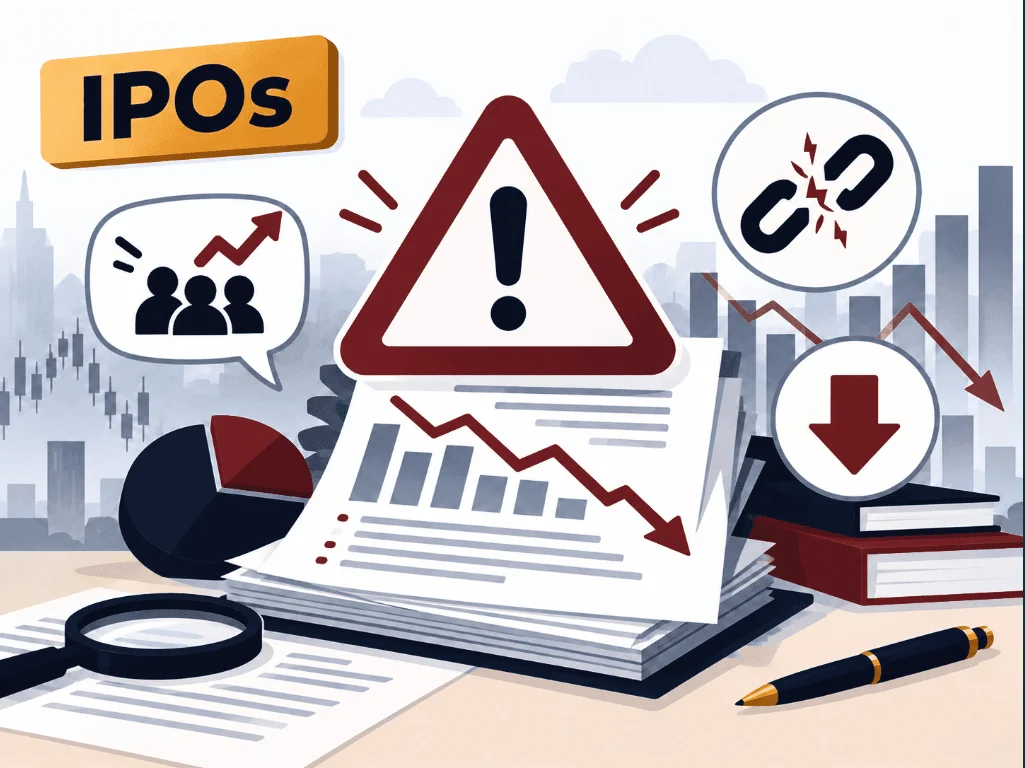
- Chasing Grey Market Premium (GMP). It’s unofficial, unregulated, and can swing wildly in days. It reflects speculative sentiment, not business fundamentals.
- IPOs that are overwhelmingly OFS-heavy with minimal fresh capital going into the actual business.
- A single unusually strong quarter right before filing, dressing up otherwise weak historical financials.
- High promoter share pledging (shares used as loan collateral) — a sign of financial stress at the promoter level.
- Marketing hype outpacing disclosed fundamentals — if the ads are louder than the numbers in the RHP, that’s worth noticing.
- Investing money you might need soon. Allotment isn’t guaranteed, and even if you get shares, listing-day price swings can go either direction.
- Putting a large share of your capital into a single IPO. Diversification applies here exactly as it does everywhere else in investing.
A Simple Evaluation Checklist
| Revenue trend (3+ years) | Steady growth, not a one-time pre-IPO spike |
| Profit margins | Positive and stable, or a clear, credible path to profitability |
| Debt-to-equity ratio | Manageable relative to industry peers |
| Fresh Issue vs. OFS split | Meaningful fresh capital actually funding the business |
| Valuation vs. listed peers | Reasonably justified, not wildly inflated |
| Promoter holding change | No excessive pre-listing exit |
| Litigation/regulatory disclosures | Nothing materially unresolved or concerning |
| Your own capital allocation | Only investing money you can afford to have locked up or lose |
Common Mistakes First-Time IPO Investors Make
- Applying based only on GMP or social media buzz, without opening the prospectus at all.
- Assuming “oversubscribed” automatically means “good investment” — it means high demand, which is a different thing.
- Missing the UPI mandate deadline and having a valid application rejected for a technicality.
- Applying through multiple brokers with the same PAN, resulting in every application being rejected.
- Treating an IPO application like a guaranteed listing-day profit rather than an investment decision with real risk.
FAQs
Is applying for an IPO guaranteed to get me shares?
No. Allotment depends on demand, especially in oversubscribed issues, where retail allotment is often decided by a lottery-style process.
Does the “cut-off price” option help my chances?
It’s generally recommended for retail investors — it signals you’re willing to pay whatever final price is set within the band, which is treated favorably over a lower fixed bid.
Should I sell on listing day if the stock is trading above the issue price?
That’s a personal decision based on your own goals and risk tolerance — this guide isn’t the place for that call. What matters is that you made the original decision to apply based on the company’s fundamentals, not just hype.
1 thought on “Complete Guide on IPOs how to Choose, Analyze, and Apply in 8 simple steps”