
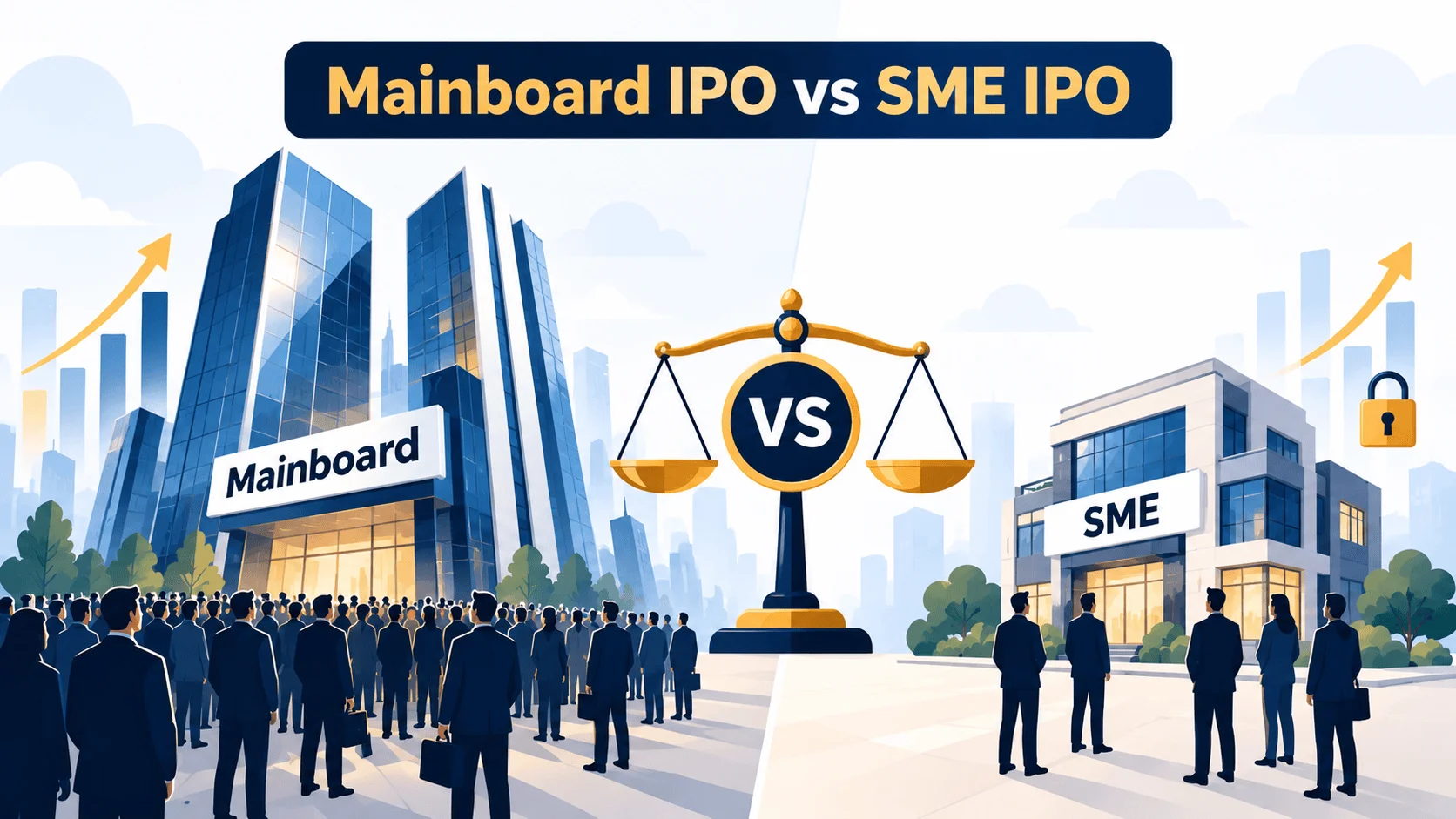
You open your broker app and see two IPOs side by side. One asks for roughly ₹15,000. The other asks for more than ₹2 lakh. Both say “IPO,” both have a price band, and both promise a chance to get in early. So what’s the real difference?
That question is exactly what the Mainboard IPO vs SME IPO debate is about, and it matters more than most beginners realize. The two are regulated, priced, and traded differently, and they carry very different risks. In this guide, we’ll first answer how many types of IPOs there are, then compare Mainboard IPO vs SME IPO point by point, and finish with a practical checklist.
Quick answer: There is no single official count of IPO “types.” Investors usually sort IPOs in three ways: by platform (Mainboard or SME), by pricing method (fixed price or book building), and by structure (fresh issue, offer for sale, or both). The Mainboard IPO vs SME IPO split is the one that changes your risk the most.
Know more about How to Invest & Choose in IPOs
How Many Types of IPOs Are There?
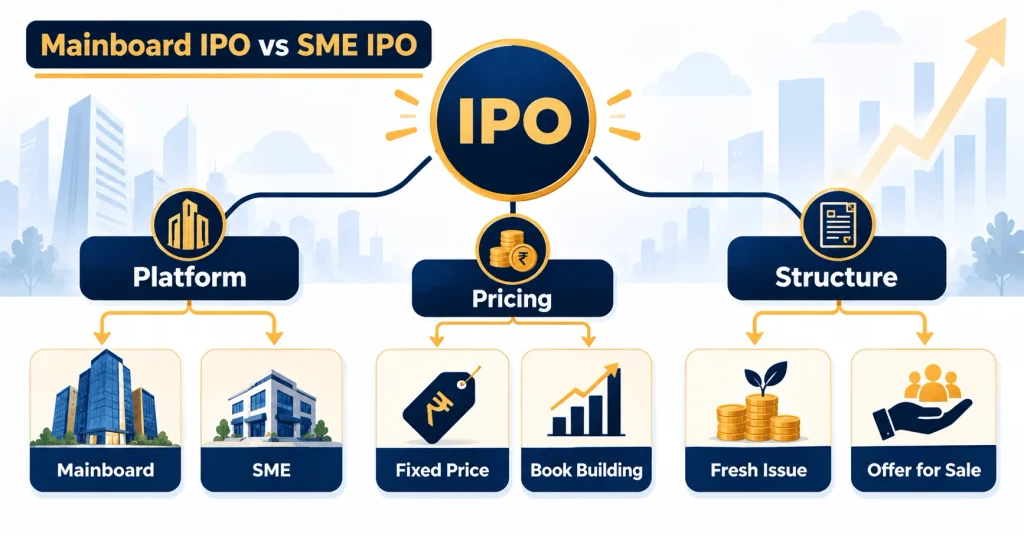
People often ask for “the” number of IPO types, but the honest answer is that it depends on how you slice it. Here are the three classifications you’ll meet most often in India.
| By platform | Mainboard IPO, SME IPO | Where the shares will trade, and how large and established the company is |
| By pricing method | Fixed-price issue, Book-building issue | How the final price is decided |
| By structure | Fresh issue, Offer for Sale (OFS), or a mix of both | Whether the money goes into the company or to selling shareholders |
By pricing method, briefly. In a fixed-price issue, the company announces one price up front. In a book-building issue, it announces a price band (for example, ₹79 to ₹84), collects bids, and fixes the final price within that band based on demand. Book building is far more common among larger issues today, while smaller issues use both formats.
By structure, briefly. A fresh issue creates new shares and the money goes to the company. An Offer for Sale means existing shareholders sell their shares, so the money goes to them. Most IPOs combine the two. We covered this in more detail in our guide on what an IPO is.
Regional note: This classification is how IPOs work in India. In other countries, the labels differ. The UK, for example, has a junior market called AIM, and the US has direct listings and SPACs alongside traditional IPOs. The principle is the same everywhere: smaller, younger companies usually list on lighter-touch platforms, and those listings carry more risk.
What Is a Mainboard IPO?
A Mainboard IPO is an IPO by a larger, more established company that lists on the main boards of the NSE or BSE. These are the IPOs you see in the news most often.
Key features:
- Stricter entry tests. Under SEBI’s ICDR rules, one common route requires net tangible assets of at least ₹3 crore, average pre-tax operating profit of at least ₹15 crore, and net worth of at least ₹1 crore, tested on restated figures over the preceding three full years. A company that doesn’t meet these tests can still list through book building if it allots at least 75% of the net offer to qualified institutional buyers (QIBs).
- Direct SEBI review. SEBI reviews the draft offer document itself.
- Broad participation. A minimum of 1,000 allottees is required, so the shareholder base is wide.
- Quarterly reporting. Listed companies publish results every quarter, so you get fresher information.
- Accessible ticket size. Retail investors can apply for up to ₹2 lakh, and a single lot is often around ₹14,000 to ₹15,000.
What Is an SME IPO?
An SME IPO is an IPO by a small or medium-sized enterprise listed on a dedicated platform: NSE Emerge or BSE SME. The idea is to give younger and smaller businesses a cheaper, lighter route to raise money from the public.
Key features:
- Size cap. On the NSE Emerge platform, the post-issue paid-up capital (at face value) cannot exceed ₹25 crore.
- Lower profit bar. NSE requires operating profit (EBITDA) of ₹1 crore in any two of the three previous financial years, positive free cash flow to equity in at least two of those three years, and a positive net worth.
- Promoter skin in the game. Promoters must hold at least 20% of post-issue equity.
- Exchange vetting. The stock exchange vets the offer document, with SEBI acting in a supervisory role.
- Market maker. A market maker is mandatory for at least three years after listing to provide buy and sell quotes.
- Half-yearly reporting. Listed SME companies report half-yearly rather than quarterly.
The rules got tighter in 2025
SEBI notified changes to SME IPO norms on 4 March 2025. The key ones: the EBITDA requirement above, a cap on Offer for Sale of 20% of the issue (with no selling shareholder allowed to sell more than 50% of their holding), a cap on general corporate purposes spending at the lower of 15% of the issue or ₹10 crore, a ban on using IPO proceeds to repay loans from promoters or related parties, and a 21-day public comment period on draft documents. A phased lock-in also applies to promoter holdings above the minimum contribution.
Then, from 1 July 2025, new NSE and BSE bidding rules took effect. Individual investors in SME IPOs must bid for a minimum of two lots, with the application value above ₹2 lakh. Cut-off price bids are not available, and bids cannot be modified or cancelled once placed.
You can read the changes as a map of what regulators saw as weak spots: thin profitability, heavy promoter exits through OFS, and money used for vague purposes. That reading is our inference, but the rule changes themselves are on record.
Mainboard IPO vs SME IPO Side by Side Comparison
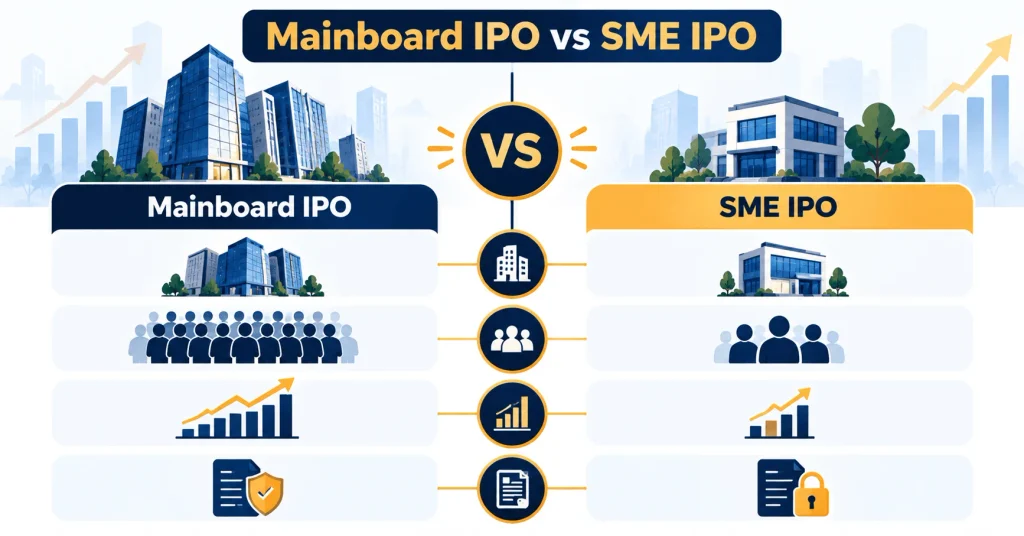
| Listing platform | NSE and BSE main boards | NSE Emerge, BSE SME |
| Company profile | Larger, established companies | Small and medium enterprises |
| Size / capital limit | No SME-style cap | Post-issue paid-up capital up to ₹25 crore (NSE Emerge) |
| Profit track record | Common route: avg. operating profit of ₹15 crore or more over three years | EBITDA of ₹1 crore in 2 of the last 3 years |
| Minimum retail application | Retail category up to ₹2 lakh; one lot often ₹14,000 to ₹15,000 | Minimum 2 lots, value above ₹2 lakh |
| Cut-off price bid | Available to retail investors | Not available |
| Changing or cancelling a bid | Generally allowed while the issue is open | Not permitted |
| Regulatory review | SEBI reviews offer documents | Exchange vets; SEBI supervises |
| Minimum allottees | 1,000 | 50 |
| Underwriting | Not mandatory | 100% underwriting mandatory |
| Market maker | Not required | Mandatory for 3 years |
| Reporting after listing | Quarterly results | Half-yearly results |
| Liquidity | Generally high | Generally low |
| Overall risk | Comparatively lower | Generally higher |
Figures reflect rules and exchange pages checked on 16 October 2026. Always confirm the latest numbers in the offer document and on the NSE/BSE websites before applying.
Risks of SME IPOs
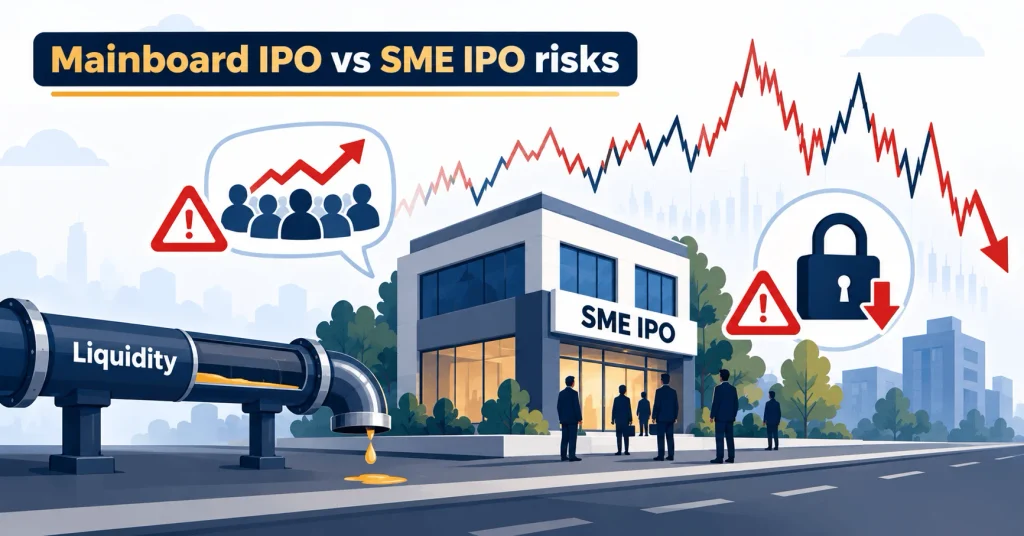
The Mainboard IPO vs SME IPO question comes down to risk, so let’s be specific about the SME side.
- Low liquidity. Fewer shares trade, and fewer people trade them. You may find it hard to sell at the price you want, or sell quickly at all.
- Sharp price swings. Thin trading means a small amount of buying or selling can move the price a lot.
- The market maker is temporary. Market-making support is required for three years. After that, nothing guarantees the same level of two-way quotes.
- A high ticket size. With a minimum above ₹2 lakh, one SME application is a big bet for a first-time investor. Concentrating that much money in a small, illiquid company is risky.
- Less frequent information. Half-yearly reporting means you see financial updates less often than for a mainboard company.
- Business concentration. Many small companies depend on a few customers, a single product, or one region. Check the risk factors in the offer document for this.
- Hype-driven demand. Grey market chatter and social media buzz can overshadow weak fundamentals. Chasing a listing pop is not an investment thesis.
- Rigid bidding. No cut-off price and no bid modification mean you must decide carefully before you click apply.
Risks of Mainboard IPOs
Mainboard doesn’t mean safe. Common risks include:
- Aggressive pricing. Valuations may be set high relative to listed peers, leaving little room for gains after listing.
- OFS-heavy issues. If most of the issue is an Offer for Sale, little new capital goes into the business.
- Listing below the issue price. Plenty of IPOs list weaker than expected, especially when demand was driven by hype.
- Lock-in expiries. When promoter or anchor lock-ins end, a rush of selling can pressure the price.
- Business and sector risk. A big company can still face debt, regulatory, or competitive problems.
Mainboard IPO vs SME IPO Which One Suits Which Investor? (A Framework, Not Advice)
| A first-time IPO applicant with a modest budget | Starting with Mainboard IPOs, where the ticket size is smaller and information is easier to find |
| Comfortable reading offer documents and holding illiquid positions | Researching SME IPOs carefully, with money you can afford to lock up |
| Chasing quick listing gains | Pausing first. Listing gains aren’t guaranteed in either category |
| Planning to hold for years | Looking closely at profitability, debt and promoter intent in either category |
This table describes trade-offs, not a recommendation. Your own goals, income, and risk tolerance decide what fits you.
A Simple Checklist Before Applying to Either
- Read the risk factors in the RHP first, before any marketing.
- Check three years of revenue, profit, and debt. Look for consistency, not one strong year just before the IPO.
- See how the money is used. Prefer fresh issues funding real growth over large promoter exits.
- Compare valuation with similar listed companies.
- Confirm the platform. Know whether it’s Mainboard or SME before you check the lot size.
- Check your cash. For an SME IPO, can you comfortably block more than ₹2 lakh, and could you live with that money being stuck?
- Ignore GMP as a signal. It’s an unofficial number, not market data.
- Plan your exit. Ask how you’d sell if liquidity dried up.
Common Mistakes to Avoid
- Treating Mainboard IPO vs SME IPO as only a difference in ticket size, when the liquidity and disclosure gaps matter just as much.
- Applying to an SME IPO because of listing-day stories without reading the offer document.
- Putting a large share of your savings into one small-company IPO.
- Missing the 5:00 PM UPI mandate deadline on the last day.
- Assuming oversubscription proves the business is sound. It only shows demand.
FAQs
How many types of IPOs are there?
There’s no official count. The common classifications are by platform (Mainboard and SME), pricing method (fixed price and book building), and structure (fresh issue, Offer for Sale, or both).
What is the main difference in Mainboard IPO vs SME IPO?
Size and regulation. Mainboard IPOs are by larger companies with stricter entry tests and listing on the main boards. SME IPOs are by smaller companies on NSE Emerge or BSE SME, with lighter requirements, a higher minimum application, and generally lower liquidity.
Are SME IPOs riskier than Mainboard IPOs?
Generally yes, because of lower liquidity, bigger price swings, and less frequent reporting. But individual Mainboard IPOs can also lose money, so every issue needs its own research.
What is the minimum investment in an SME IPO?
Under the rules effective 1 July 2025, individual investors must bid for at least two lots, with an application value above ₹2 lakh. The exact amount depends on the issue price and lot size.
Can I use the cut-off price in an SME IPO?
No. Under the 2025 NSE and BSE rules, cut-off price bids are not available in SME IPOs, and bids can’t be modified or cancelled.
Can an SME company move to the main board later?
Yes. Companies can migrate from SME platforms to the main board after meeting the applicable criteria, and SEBI also allows SME-listed companies to raise further capital under certain conditions. Check the current exchange rules for details.