
You applied for an IPO, approved the UPI mandate, and now you keep refreshing your phone. The step that decides whether you actually receive shares is IPO allotment, and for popular issues the honest answer is often “no.” Once you understand how IPO allotment works, the waiting gets less stressful, and the myths lose their grip.
This guide explains the whole IPO allotment process ; who decides, what the timeline looks like, how the lottery works, why applications get rejected, and how to check your result. If you’re new to the topic, start with what an IPO is and come back.
Quick answer: IPO allotment is the stage after an IPO closes when the registrar decides how many shares each applicant gets. If a category is not fully subscribed, valid applicants receive what they bid for. If it is oversubscribed, retail applicants are usually chosen by a lottery and receive one lot each, while larger investors are allotted proportionately.
What Is IPO Allotment?
IPO allotment is the process of distributing the shares on offer among everyone who applied. Applying only means you asked for shares. Allotment is the decision about whether you get them, and how many.
Two parties run it. The registrar to the issue (a company such as KFin Technologies or MUFG Intime) checks the applications and prepares the basis of allotment. The designated stock exchange (NSE or BSE) reviews and approves it before shares are credited. SEBI’s issue-of-capital regulations govern the rules for allotting IPO shares.
Your money is never “spent” while you wait. With UPI or ASBA, the amount is only blocked in your bank account. If you are not allotted shares, the block is released. If you are, only the amount for the shares you received is debited.
IPO Allotment Timeline What Happens After the IPO Closes
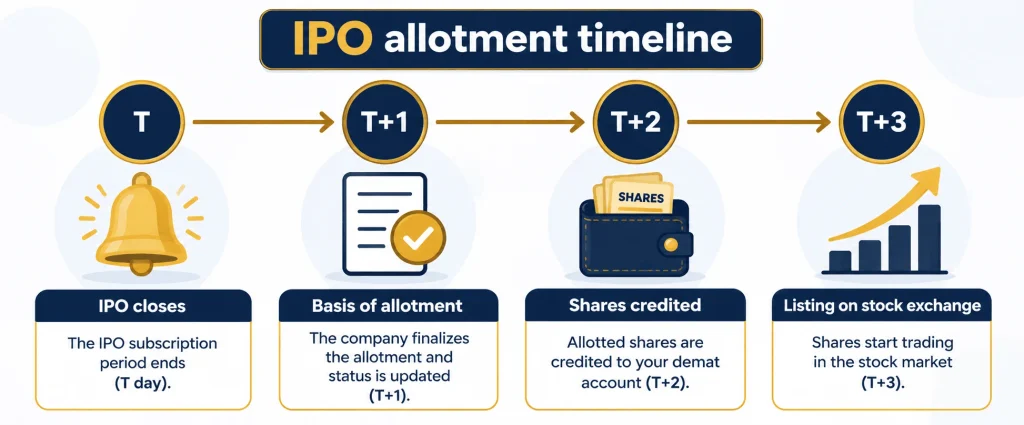
The timeline is counted in working days from the closing day (called T day). SEBI cut the listing timeline from T+6 to T+3 in a circular dated 9 August 2023, and the shorter schedule became mandatory for all issues launched after 1 December 2023, as reported by LiveLaw.
| T day | Bidding closes. For UPI bids, the mandate must be approved by 5:00 PM on the last day. |
| T+1 | The registrar finalises the basis of allotment, and you can check your allotment status. |
| T+2 | Shares are credited to your demat account, and blocked funds are released for those not allotted. |
| T+3 | The shares list and start trading on the exchange. |
Weekends and exchange holidays push IPO allotment dates out, because only working days count. For example, Hero Motors’ IPO was announced to close on Friday, 18 September 2026, with allotment on Monday 21 September, credit on Tuesday 22 September, and listing on Wednesday 23 September. That is exactly T+1, T+2, and T+3 across a weekend.
Who Gets What How Shares Are Split Across Investor Categories
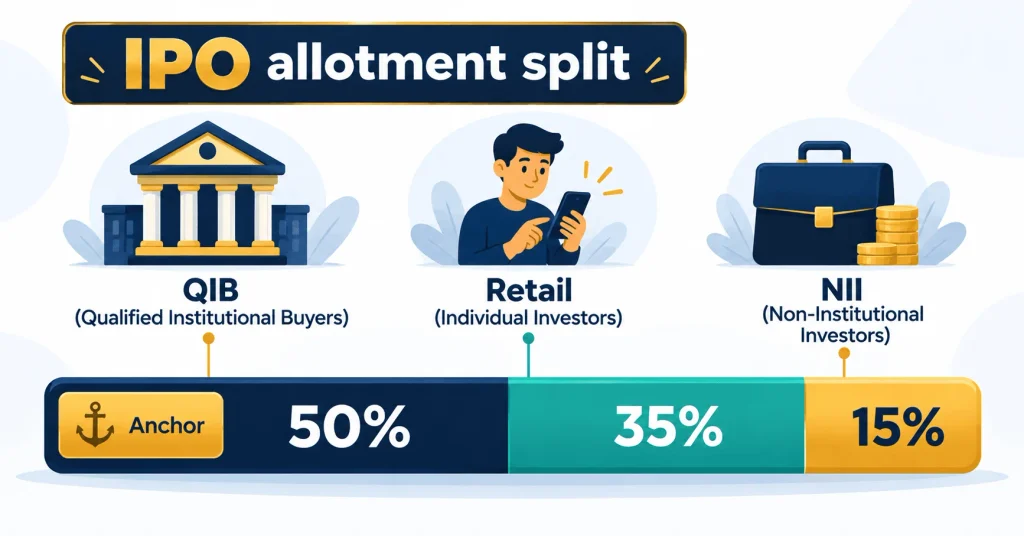
Shares are reserved for different groups before IPO allotment starts. In the standard book-built structure, an exchange-filed basis of allotment document shows these limits:
| Retail (RII) | At least 35% | Individuals bidding up to ₹2 lakh | Lottery if oversubscribed; one lot per winner |
| Non-institutional (NII) | At least 15% | Bids above ₹2 lakh; one-third for ₹2 to ₹10 lakh, two-thirds above ₹10 lakh | Proportionate to bids |
| QIB | Up to 50% | Mutual funds, foreign investors, banks, insurers | Proportionate; anchor investors are 60% of this portion |
A simple picture helps. In an issue of 1,00,000 shares with this structure, about 30,000 go to anchor investors, 20,000 to other QIBs, 15,000 to NIIs, and 35,000 to retail applicants. Anchor investors are large institutions that buy at a fixed price a day before the IPO opens, so they never take part in the public lottery.
These splits describe the standard structure. Issues that use the QIB route, for example, allot at least 75% to QIBs, and SME issues have their own bidding rules. Our guide on Mainboard IPO vs SME IPO covers those differences. Always confirm the split in the offer document.
How IPO Allotment Works 7 Essential Steps
Here is the sequence the registrar and exchange follow after the issue closes.
Step 1: Bidding closes, and bid data goes to the registrar
When the window ends, the exchanges pass every valid bid to the registrar. This includes your PAN, demat details, quantity, price, and payment block.
Step 2 The: registrar validates every application
The registrar rejects technical errors. Common ones are a wrong PAN, mismatched demat details, duplicate applications under one PAN, and UPI mandates that were never approved.
Step 3: Subscription is calculated for each category
The registrar divides the number of shares bid for by the number on offer, category by category. A figure of 10x means applicants asked for ten times the shares available in that category.
Step 4: The basis of allotment is decided
This is the heart of IPO allotment. If a category is undersubscribed, every valid applicant receives the shares they bid for. If it is oversubscribed, the lottery or proportionate method applies, as explained in the next section.
Step 5: The exchange approves the basis of allotment
The registrar finalises the allotment with the designated exchange, which approves the basis. The company then publishes it. This usually happens on T+1.
Step 6: Shares are credited, and funds are settled
Once the basis is approved, IPO share allotment is completed: the shares move into your demat account, and the money for them is debited. If you got nothing, the blocked amount is released. Both usually happen by T+2.
Step 7: The stock lists
On T+3, the shares begin trading on the exchange. Only now can you sell them.
How the Retail IPO Allotment Lottery Works
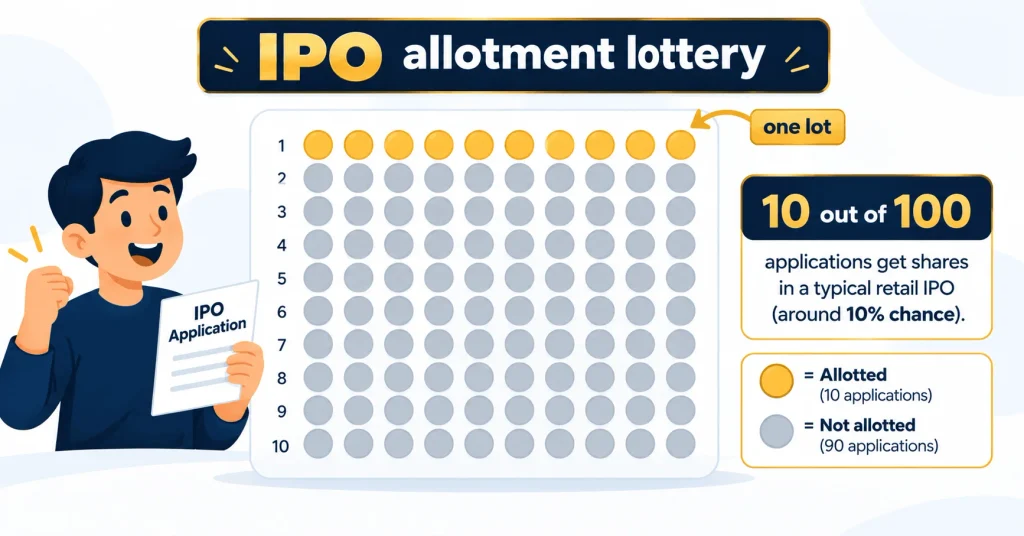
When retail demand exceeds the shares reserved, a computerised lottery picks the winners. Each winner receives one lot, whatever number of lots they applied for, as Groww’s explainer on the basis of allotment describes.
Here is an illustrative example (the numbers are made up to show the logic):
| Lot size | 100 shares |
| Shares reserved for retail | 35,000 |
| Lots available | 350 |
| Valid retail applications | 3,500 |
| Subscription | 10 times |
| Applicants who win a lot | 350 |
| Chance for any one application | about 10% |
Two things follow from this. First, when a lottery is held, applying for several lots does not raise your odds, because each valid application is one ticket and a winner gets one lot. It only blocks more of your money. Second, a 10x subscription does not mean 10% of people get shares in a neat pattern. It is a draw, so luck decides.
For non-institutional investors, allotment is mostly proportionate. If the category is subscribed 10 times and you bid for 100 lots, you would receive roughly 10 lots, with small draws used for any remainder.
Why You May Not Get IPO Allotment
Missing IPO allotment is not always bad luck. Sometimes the application never counted. Sources such as INDmoney’s allotment guide list most of the usual causes.
| UPI mandate not approved in time | The bid is not counted | Approve the request immediately, and before 5:00 PM on the last day |
| More than one application per PAN | Duplicates may be rejected | Apply once per PAN, from one broker |
| Wrong PAN or demat details | Application rejected | Check PAN, DP ID and client ID before submitting |
| Bid below the final issue price | Bid becomes invalid | Bid at the cut-off price as a retail investor |
| Funds not blocked | Application fails | Keep enough balance and confirm the block |
| Not picked in the lottery | Valid, but unlucky | Nothing: your money is released |
If your demat details are out of date or you do not have an account yet, fix that before the next issue opens.
Need a demat account for the next IPO? You need a demat and trading account with a SEBI-registered broker before you can apply. Compare charges, app quality, and IPO support first. [Open a demat account — AFFILIATE LINK PLACEHOLDER]
How to Check IPO Allotment Status
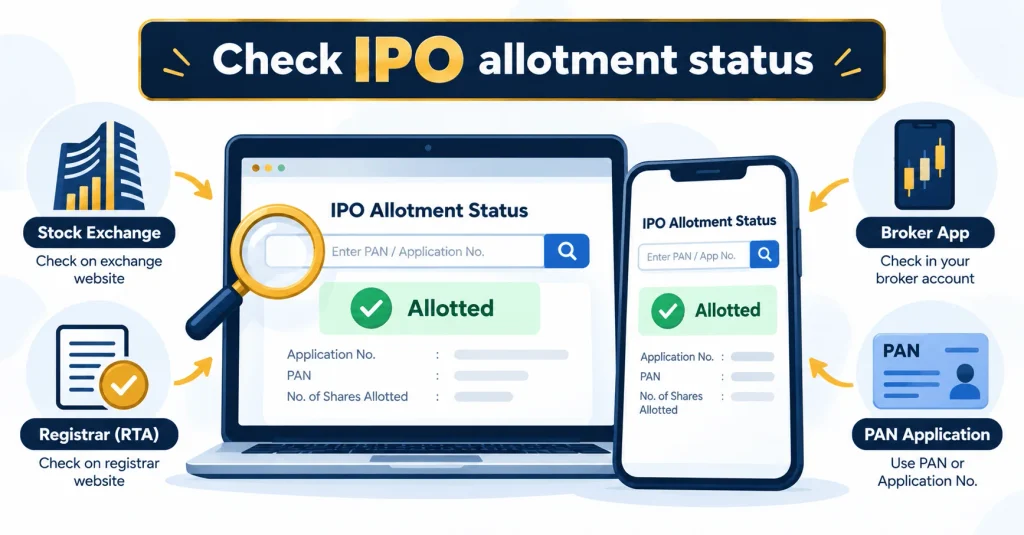
You can check your allotment status once the basis of allotment is finalised, usually from T+1, in four places. The offer document names your IPO’s registrar.
| BSE | BSE IPO application check page |
| NSE | NSE IPO bids and status page |
| Registrar: MUFG Intime | MUFG Intime public issues |
| Registrar: KFin Technologies | KFintech IPO status |
Select the IPO name, then enter your PAN, application number, or DP ID and client ID. Registrar sites often show results first, so try the other site if one shows nothing. Your broker app will also update once shares are credited.
Can You Improve Your Chances of Getting Shares?
No tactic can promise IPO allotment, but a few habits keep you from losing chances through errors.
- Apply once per PAN. Family members with their own PAN and demat account can each apply, but only from their own accounts and with their consent.
- Bid at the cut-off price as a retail investor, so the bid stays valid at the final price.
- Approve the UPI mandate right away, not at the last minute.
- Do not chase more lots for the retail lottery. It does not improve your odds.
- Ignore anyone who sells assured allotment. No agent or “tip group” can control the lottery, so treat such offers with suspicion.
What Happens After the Allotment Result
Here is what follows once IPO allotment is final.
If you are allotted shares: they appear in your demat account by T+2, the money for them is debited, and you can sell after listing on T+3. Before applying, it helps to evaluate the company’s financials, because allotment only gives you the shares, not a profit.
If you are not allotted, the blocked amount is released, usually by T+2. Nothing is lost, and you can apply to the next IPO.
Common Mistakes Applicants Make
These slip-ups can cost you IPO allotment before the lottery even starts.
- Assuming a heavily subscribed issue means a fair chance for everyone.
- Applying from two brokers with one PAN.
- Entering wrong demat details because they were saved long ago.
- Missing the 5:00 PM mandate deadline on the last day.
- Taking a loan or using emergency money to apply.
- Treating the lottery as a skill you can beat.
FAQs
What is IPO allotment?
It is the process after an IPO closes in which the registrar and exchange decide how many shares each applicant receives. Applying does not mean you will get shares.
How long does IPO allotment take?
The basis of allotment is finalized on T+1, shares are credited by T+2, and the stock lists on T+3, counted in working days.
Is IPO allotment random?
For retail applicants in an oversubscribed issue, yes: a computerised lottery picks winners. For larger investors, allotment is mostly proportionate to the bid.
What if the IPO is undersubscribed?
Every valid applicant receives the shares they applied for. Under the rules, an issue generally needs a minimum subscription of 90%, or money is refunded.
Does “not allotted” mean I lose my money?
No. The amount was only blocked, and it is released after the allotment is finalized.
Can I check my IPO allotment result without a PAN?
Registrar sites also accept your application number, your DP ID, and your client ID.
Disclaimer
This article is for educational purposes only and is not investment advice or a recommendation to buy or sell any security. Allotment rules, timelines and deadlines can change, so confirm the latest details in the offer document and on the NSE, BSE and SEBI websites. Please speak to a licensed financial adviser before investing.
Sources Checked
(18 October 2026)
- Exchange-filed basis of allotment document (NSE)
- Basis of allotment in an IPO (Groww)
- How to check IPO allotment status (INDmoney)
- SEBI T+3 listing timeline (LiveLaw)
- BSE application check · NSE bids and status
- MUFG Intime · KFin Technologies
Keep Learning With Financier Mind
More IPO guides are in our IPOs category. For short explainers, follow us on YouTube or join our WhatsApp channel.