

Every few weeks, you’ll see headlines like “XYZ Company IPO Opens Today” or “ABC Ltd. Lists at 30% Premium.” If you’ve ever wondered what’s happening behind those headlines—what an IPO is, how it works, and whether you should even pay attentionto —this guide is for you.
We’ll build this up from the basics, then walk through a real IPO opening in just days from now: Hero Motors, the auto-parts and powertrain manufacturer linked to the Hero Group.
Really What Is an IPO?
IPO stands for Initial Public Offering. In plain terms, it’s the first time a private company sells shares to the general public, turning it into a publicly listed company.
Think of it like this — before an IPO, a company is like a members-only club. Only founders, employees, and private investors (venture capital firms, angel investors) hold a stake. An IPO is the company opening its doors and saying, “Now anyone with a demat/brokerage account can own a small piece of us too.”
Once the IPO is done, the company’s shares start trading freely on a stock exchange — that’s the “going public” part.
Why Do Companies Go Public?
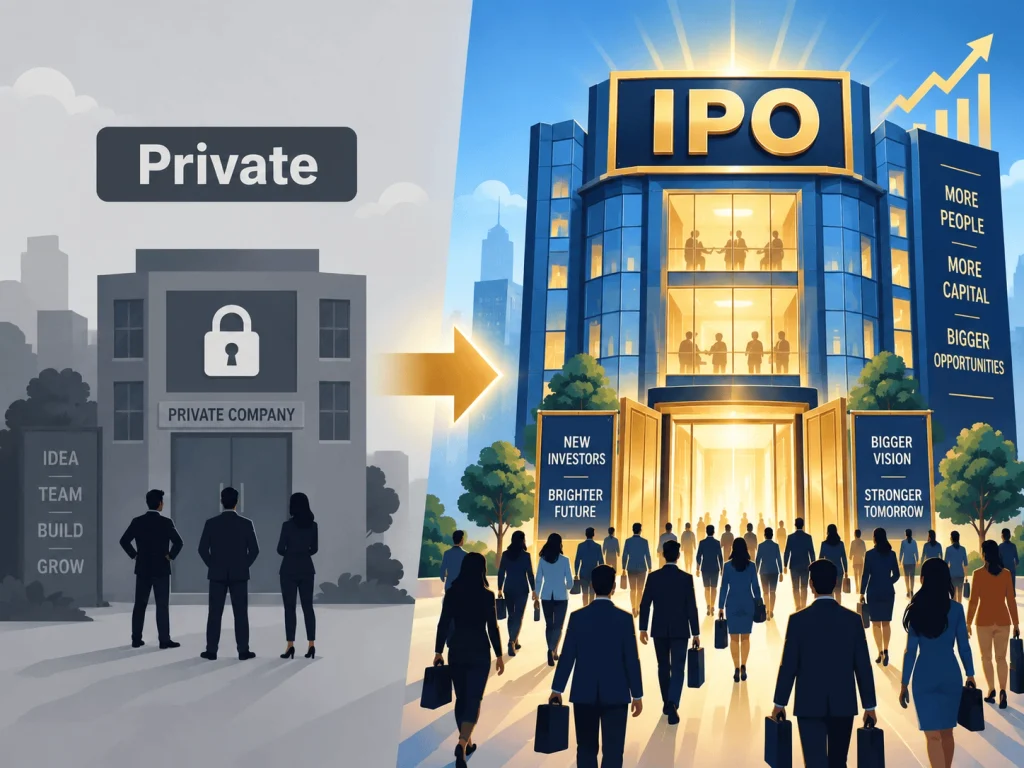
Companies don’t do this lightly — an IPO is expensive, heavily regulated, and exposes the company to public scrutiny. They do it anyway because it solves real problems:
- Raising capital — to expand operations, pay off debt, or fund new projects, without taking on more loans.
- Giving early investors an exit — venture capitalists and early employees who’ve held private shares for years finally get a way to sell them.
- Building credibility and visibility — being listed on a stock exchange comes with a certain stamp of legitimacy and brand recognition.
- Using shares as currency — publicly listed companies can more easily use their stock to acquire other companies or attract talent through stock options.
Key IPO Terms You’ll Keep Running Into
Before we go further, here are the terms you need in your vocabulary — we’ll use every one of these in the real example below.
| Prospectus / Offer Document | The official document a company files with regulators before an IPO, disclosing its financials, risks, and business model. In India this is called a DRHP (Draft Red Herring Prospectus); in the US it’s an S-1 filing with the SEC. |
| Price Band | The price range within which investors can bid for shares (e.g., ₹384–₹404). The final price is set within this band based on demand. |
| Fresh Issue | New shares the company creates and sells — this money goes directly into the company. |
| Offer for Sale (OFS) | Existing shareholders (founders, early investors) selling their own shares — this money goes to them, not the company. |
| Lot Size | The minimum number of shares you must bid for in one application (you can’t buy just 1 share in most IPOs). |
| Anchor Investors | Large institutional investors allowed to buy shares a day or two before the public issue opens, at a fixed price — used to build early confidence. |
| Listing | The day the shares officially start trading on the stock exchange. |
| Grey Market Premium (GMP) | An unofficial, informal indicator of what traders are willing to pay for shares before they list — more on why to be careful with this below. |
Learn about financial ratios more Click Here
How the IPO Process Actually Works
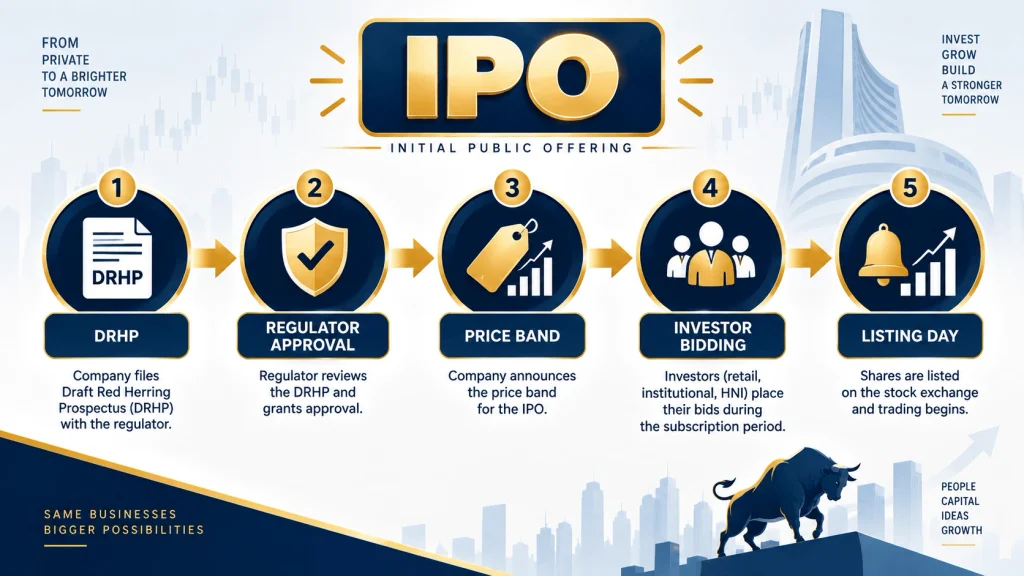
The exact regulator and paperwork names change by country, but the underlying sequence is nearly universal:
- The company decides to go public and hires investment banks (called “book-running lead managers”) to manage the process.
- It files a draft prospectus with the market regulator — SEBI in India, the SEC in the US, the FCA in the UK — disclosing financials, business risks, and how it plans to use the money raised.
- The regulator reviews and approves the filing, sometimes asking for changes or more disclosures.
- The company announces the price band and IPO dates, and the anchor book opens for large institutional investors a day or two before the public window.
- The public subscription window opens — usually for 3 working days — during which retail and institutional investors submit bids.
- Shares are allotted based on demand — if a category is oversubscribed, allotment is done via a lottery-style process for retail investors.
- The stock lists on the exchange, and from that point, it trades freely like any other stock.
Regional note: Terms like “DRHP,” “lot size,” and the SEBI approval process are specific to India. In the US, for example, there’s no fixed “lot size” — you can typically buy any number of shares — and pricing is set by underwriters rather than a public price band. The concept is universal; the mechanics vary by country.
Who Can Invest in an IPO?
In India, IPO shares are reserved across a few investor categories:
- QIB (Qualified Institutional Buyers) — mutual funds, banks, insurance companies.
- NII (Non-Institutional Investors) — high-net-worth individuals investing larger amounts.
- Retail Individual Investors — everyday investors like you, typically capped at a maximum investment amount per application.
Globally, this usually simplifies to two broad buckets: institutional investors (who get first access, often through the anchor book) and retail/individual investors (the general public).
Real-World Example The Hero Motors IPO (Opening September 2026)
Rather than talk in the abstract, let’s apply everything above to a real IPO opening in just a few days.
Who Is Hero Motors? (And a Quick but Important Distinction)
Here’s a mix-up worth clearing up, because it trips people up constantly: Hero Motors is not Hero MotoCorp.
Hero MotoCorp — India’s largest two-wheeler manufacturer by volume — has been a publicly listed company for years already. It is not the one having an IPO. Hero Motors is a separate company, run by Pankaj Munjal of the same Munjal family, that designs and manufactures auto powertrain and transmission components — gears, transmission systems, and alloy/metallic parts — supplying global OEMs including Hero MotoCorp itself, BMW, and Ducati. Think of it as a components supplier to Hero MotoCorp and other major automakers, not the two-wheeler brand you’re picturing.
This is exactly the kind of detail worth double-checking before you invest in — or write about — any company: a similar-sounding name doesn’t mean it’s the same business.
Breaking Down Hero Motors’ IPO Numbers
| Detail | Hero Motors IPO |
|---|---|
| Type | Mainboard IPO (listing on both BSE and NSE) |
| Total Issue Size | ₹1,000 crore |
| Fresh Issue | ₹600 crore (money going into the company) |
| Offer for Sale (OFS) | ₹400 crore (promoter shareholders selling part of their stake) |
| Price Band | ₹79 – ₹84 per share |
| Lot Size | 178 shares |
| Minimum Investment (Retail) | Approximately ₹14,952 |
| Subscription Window | September 16–18, 2026 |
| Tentative Listing Date | September 23, 2026 |
| DRHP Filed | June 30, 2025 |
(Numbers as of publication date — always check the exchange or registrar’s website for the latest status before making any decision.)
What This One IPO Example Teaches You
Look at how much of what we just covered shows up in this single IPO:
- Fresh Issue vs. OFS in action: Only ₹150 crore of the ₹1,255+ crore raised is actually going into Rentomojo’s business (for things like paying down debt and general corporate use). The much larger ₹1,105+ crore portion is existing shareholders cashing out part of their stake — this is completely normal for IPOs, but it’s exactly the kind of detail beginners skip past without understanding what it means for the company versus its investors.
- Reading a price band: The ₹384–₹404 band tells you the company and its bankers believe this is a fair value range — the final price gets set based on how much demand shows up during the subscription window.
- Why lot size matters: You can’t invest any amount you like — you’re bound by the 37-share lot, which is why the “minimum investment” figure exists.
A Word on GMP — Please Read This Part
You’ll see “Grey Market Premium” numbers floating around for almost every IPO, including this one. GMP is an unofficial, informal figure — it reflects what some traders are privately willing to pay before listing, but it isn’t published or backed by any exchange, and it can swing wildly (sometimes by 3–5x) in just a few days. It is not a reliable predictor of listing-day performance, and no beginner should treat it as investment advice or a signal to apply. Think of it as market gossip, not market data.
Common IPO Myths That Trip Up Beginners
- “IPOs always give listing gains.” False. Plenty of IPOs list below their issue price, especially when oversubscription or grey-market hype outpaces the company’s actual fundamentals.
- “A hyped or oversubscribed IPO means it’s a good investment.” Oversubscription tells you about demand, not about whether the business is fundamentally sound.
- “Retail investors always get allotted shares if they apply.” In heavily oversubscribed IPOs, allotment for retail investors is decided by lottery — applying doesn’t guarantee you get shares.
A Simple Checklist Before You Consider Any IPO
- Read the prospectus (DRHP/RHP) — at least the summary, risk factors, and use of proceeds sections.
- Check whether it’s mostly a Fresh Issue (money for growth) or mostly an OFS (existing investors exiting) — this tells you a lot about intent.
- Look at revenue growth and profitability — growth alone doesn’t mean a healthy business.
- Ignore GMP as a decision-making factor.
- Understand the lock-in period for promoters/anchor investors — it signals how long the people who know the business best are staying invested.
FAQ’S
Can I sell IPO shares immediately after listing?
Yes, once shares are credited to your demat account and the stock is listed, they can be sold like any other listed stock (subject to your broker’s settlement rules).
What happens if an IPO is undersubscribed?
Depending on the country’s regulations, an undersubscribed IPO may be extended, repriced, or in some cases withdrawn entirely.
Is applying for every IPO a good strategy?
Not necessarily. Each IPO should be evaluated on its own fundamentals — the checklist above is a starting point, not a substitute for real research.
Disclaimer
This article is for educational purposes only and does not constitute investment advice, a recommendation, or a solicitation to buy or sell any security. IPO details such as price bands, dates, and subscription status can change and should be verified on the official exchange (BSE/NSE), SEBI, or registrar websites before making any decision. Please consult a licensed financial advisor before investing.
2 thoughts on “What Is an IPO? A Powerful Beginner’s Guide for 2026 with live example”