
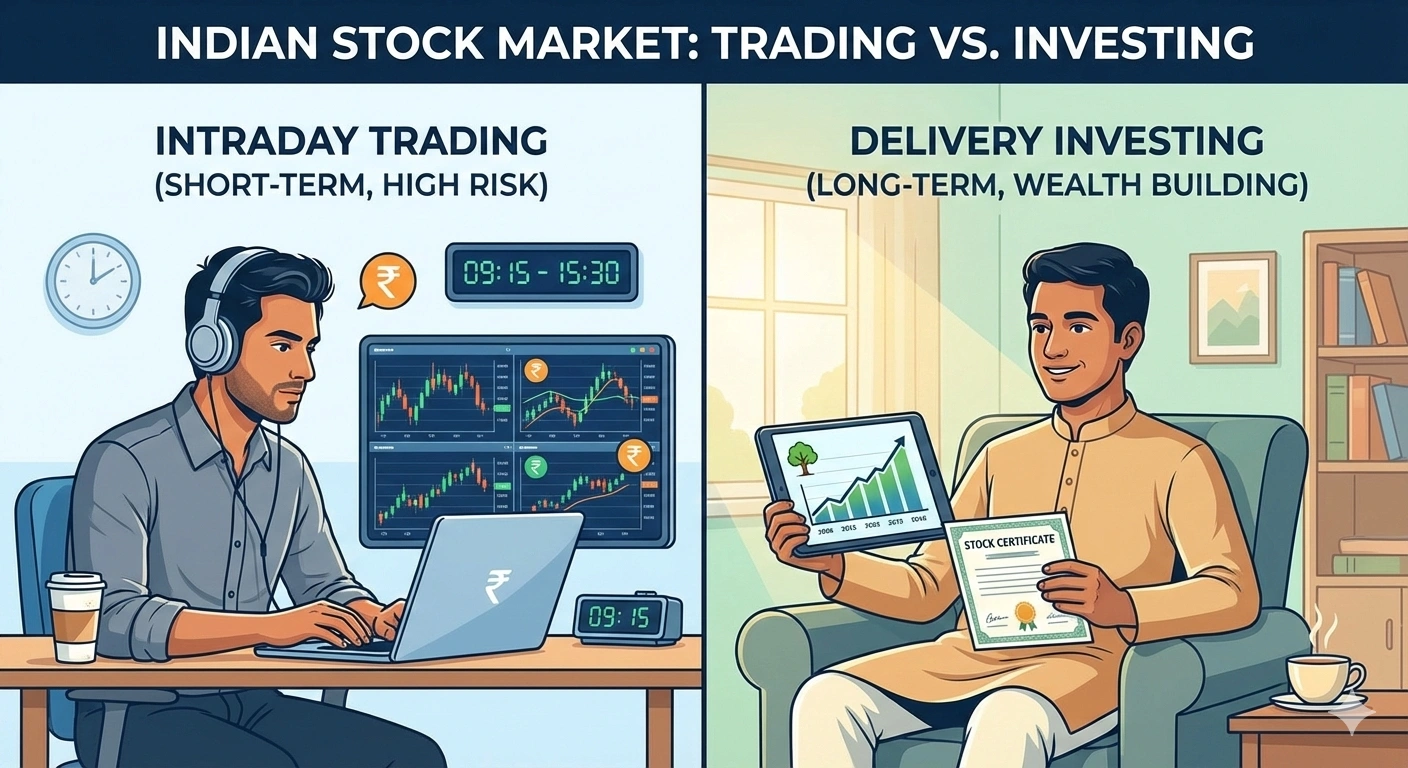
The first time I placed a trade, I faced a simple yet confusing choice. Should I buy and sell on the same day or should I hold the stock for a longer period? That moment introduced me to the world of intraday and delivery trading. Like many beginners, I did not clearly understand the difference, the purpose, or which one actually suited me. If you are standing at the same crossroads, this article is written exactly for you. n this detailed guide on Financier Mind, we will explore intraday vs delivery from basic concepts to advanced understanding.
Intraday vs delivery explained simply. Learn differences, risks, uses, and which trading style suits you best.
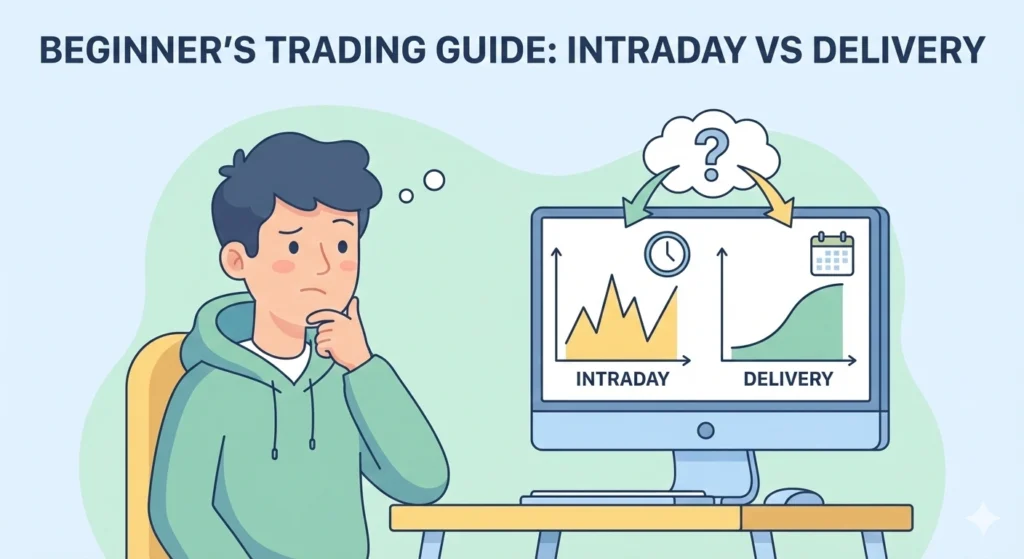
We will talk about how they work, where they are used, their risks, psychology, and finally which option may be best for you. Everything is explained in soft English, with a human touch, so you can read it calmly and come back anytime.
What Is Intraday Trading?

Intraday trading means buying and selling a stock on the same trading day. It means Day Trading. In intraday, no position is carried overnight. Whatever you buy must be sold before the market closes.
The main goal of intraday trading is to capture small price movements within a single day. Traders focus on speed, timing, and quick decisions.
Key points of intraday trading include short holding time, higher frequency of trades, and strong dependence on market momentum.
What Is Delivery Trading?

Delivery trading means buying shares and holding them beyond the trading day. When you choose delivery, the shares are credited to your demat account and can be held for days, months, or even years.
Delivery trading is often used by investors who believe in the long term potential of a company. Here, patience matters more than speed.
In delivery, you become an owner of the shares, not just a trader of price movements.
Intraday vs Delivery: Core Difference Explained
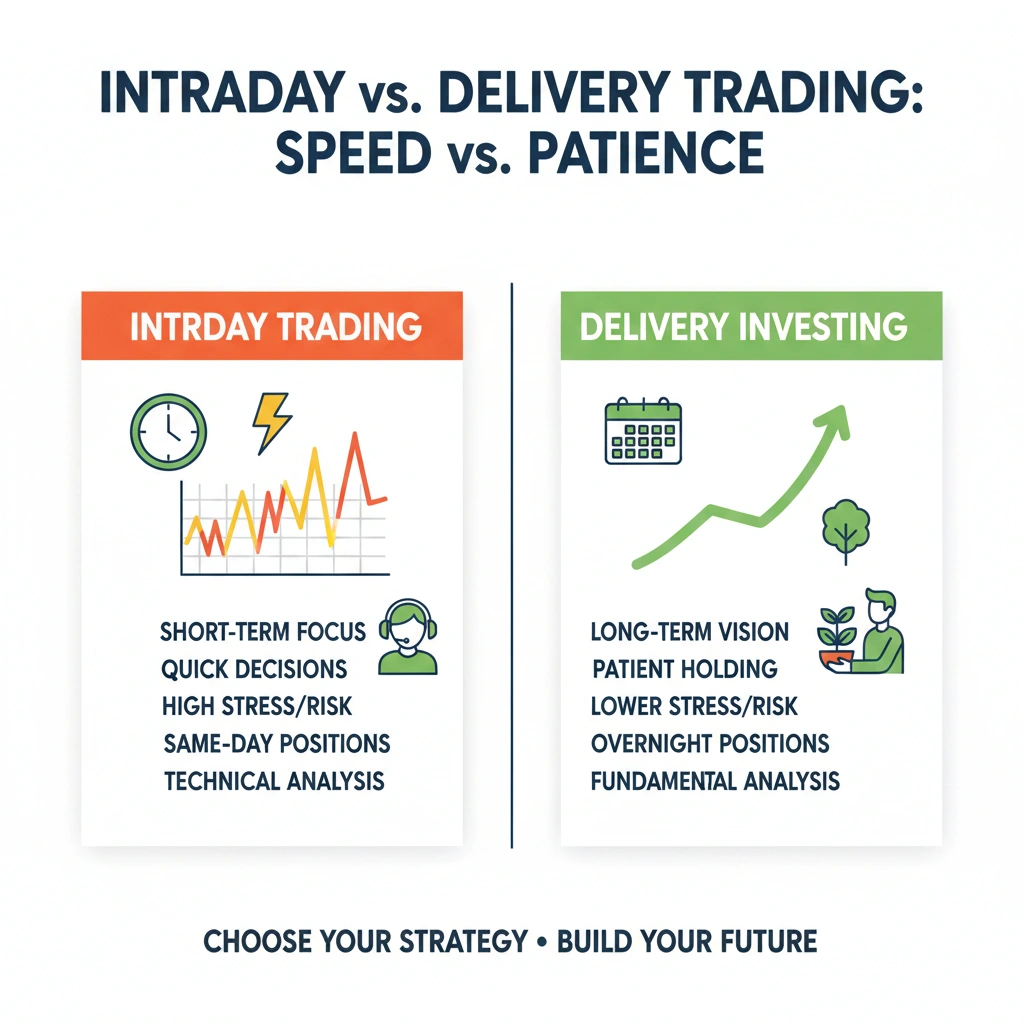
The core difference between intraday vs delivery lies in time, intention, and mindset.
Intraday trading focuses on short term price movement. Delivery trading focuses on long term value.
Intraday needs constant monitoring. Delivery needs patience and belief.
Intraday vs Delivery in the Indian Market
In India, intraday and delivery trades are both done through stock exchanges using trading platforms. However, rules and charges differ.
Intraday trades often come with lower brokerage but require square off before market close. Delivery trades involve full payment and ownership.
Understanding this difference helps avoid unnecessary losses.
Where Intraday Trading Is Used Most
Intraday trading is mostly used by active traders who can spend time watching the market.
It is common among people who:
- Prefer quick results
- Can handle pressure
- Understand charts and indicators
Intraday trading demands focus and discipline.
Where Delivery Trading Is Used Most
Delivery trading is preferred by long term investors.
It suits people who:
- Have limited time
- Believe in business growth
- Want to avoid daily stress
Delivery trading builds wealth slowly but steadily.
Intraday vs Delivery: Risk Comparison
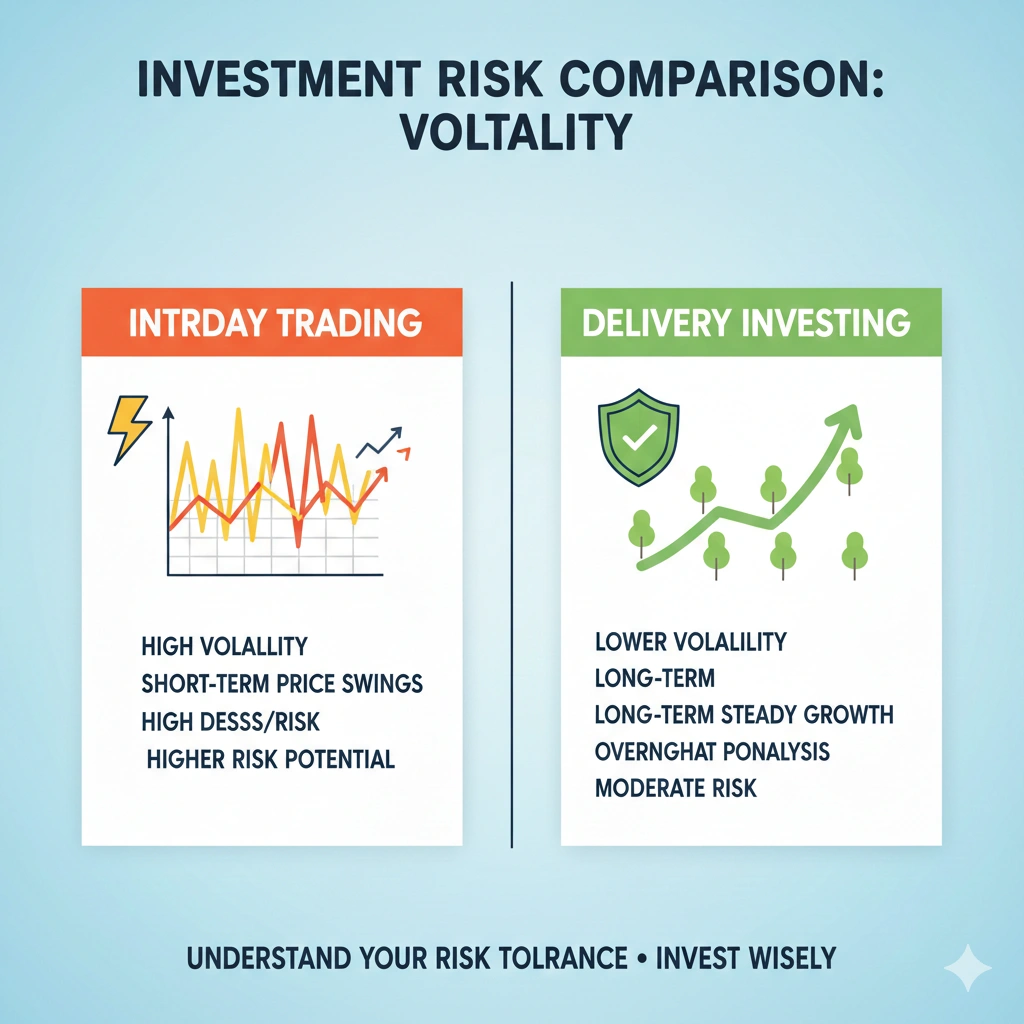
Intraday trading carries higher risk because of volatility and leverage.
Delivery trading carries lower short term risk but still faces market fluctuations.
Risk tolerance plays a major role in choosing between intraday vs delivery.
Capital Requirement in Intraday vs Delivery
Intraday trading allows margin trading. You can trade with a smaller capital using leverage.
Delivery trading requires full payment for shares.
While leverage increases opportunity, it also increases risk.
Intraday vs Delivery and Market Psychology
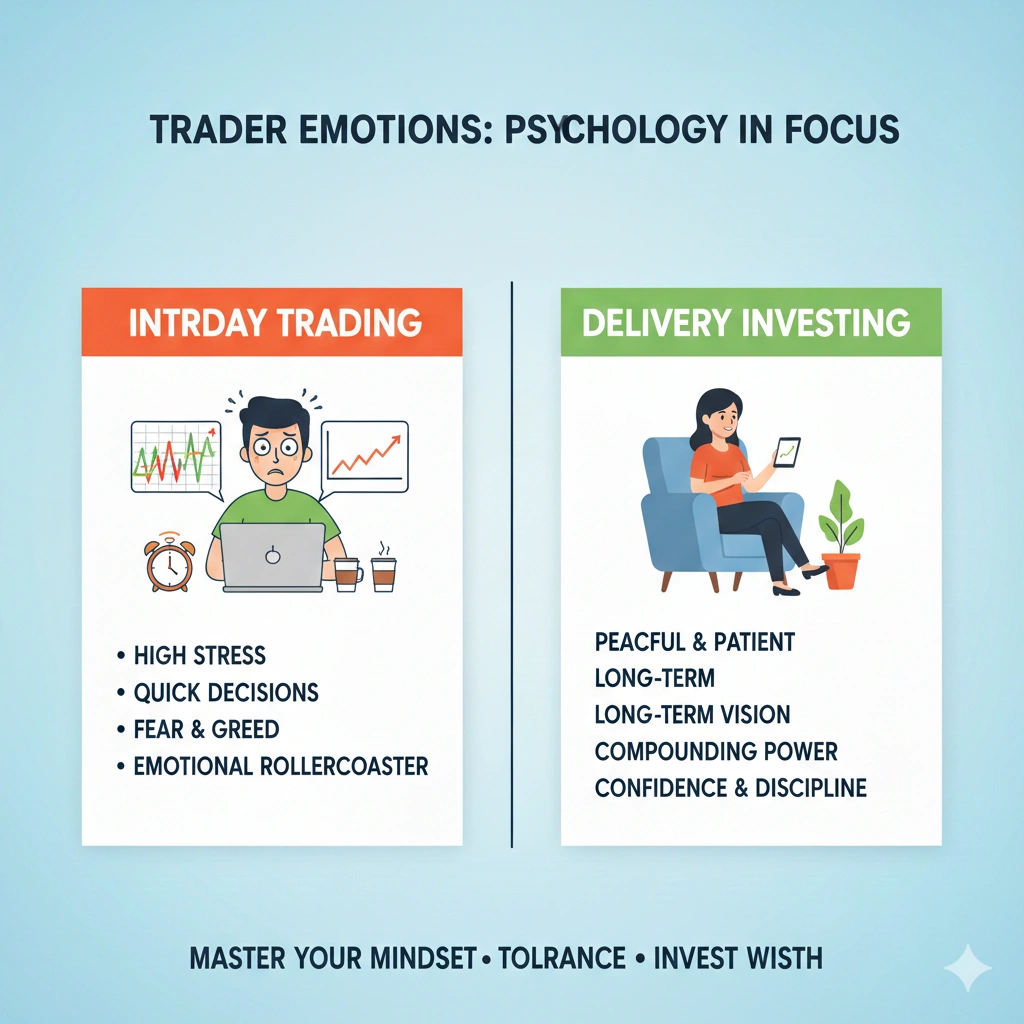
Intraday trading tests emotional control every minute. Fear and greed can appear quickly.
Delivery trading tests patience and conviction over time.
Both styles require emotional discipline, but in different ways.
Learn more in depth about Trading Psychology.
Taxation Difference in Intraday vs Delivery
Intraday trading profits are treated as business income and taxed accordingly.
Delivery trading profits may be taxed as capital gains depending on holding period.
Understanding taxation is important for realistic profit calculation.
Intraday vs Delivery for Beginners
Beginners often feel attracted to intraday because of fast money expectations.
However, delivery trading is generally safer for beginners because it allows learning without constant pressure.
Education should come before speed.
Advanced View: How Professionals See Intraday vs Delivery
Professional traders treat intraday as a probability game.
Professional investors treat delivery as a value game.
Both focus on risk management first, not profits.
Intraday vs Delivery and Risk Management
In intraday trading, stop loss is mandatory.
In delivery trading, diversification and time reduce risk.
Without Risk Management, both styles can fail.
Common Mistakes in Intraday vs Delivery
Some common mistakes include overtrading in intraday and emotional selling in delivery.
Avoiding these mistakes improves long term results.
Which Is Best: Intraday vs Delivery?
There is no universal best option.
Intraday is best for disciplined, active traders.
Delivery is best for patient, long term thinkers.
Your personality decides what works.
Can Intraday Turn Into Gambling?
Yes, when done without rules, intraday trading becomes gambling.
Structure and discipline separate trading from gambling.
Learn the difference between Trading vs Gambling in depth.
Can Delivery Still Be Risky?
Yes, poor company selection and emotional decisions can harm delivery investors.
Knowledge reduces risk.
Intraday vs Delivery in Real Life
I have seen people lose sleep over intraday trades and others calmly grow wealth through delivery investing.
Choosing the right style brings peace.
Final Thoughts
The choice between intraday vs delivery is not about which is better universally. It is about what fits your lifestyle, mindset, and goals.
Speed is not success. Consistency is.
Take time to understand yourself before choosing a trading style.
Frequently Asked Questions
Is Intraday better than delivery for beginners
- For most beginners, delivery trading is better than intraday.
- Intraday needs fast decisions and constant screen time
- Delivery allows learning without daily pressure
- Beginners can understand businesses instead of chasing prices
- Losses are easier to manage in delivery
- Intraday is not wrong, but it is not beginner-friendly without proper knowledge.
Which has more risk: intraday or delivery?
Intraday trading carries more risk.
- Intraday uses leverage, which increases losses
- Small price movements can cause quick damage
- Emotional mistakes happen faster
Delivery trading has lower short-term risk, but long-term risk still exists if you choose weak companies.
Can I do both intraday and delivery?
Yes, you can do both, but not at the same time as a beginner.
- Use delivery for long-term investing
- Try intraday only after learning risk management
- Keep separate capital for each
Mixing both without discipline often leads to confusion and losses.
Is intraday trading legal in India?
Yes, intraday trading is completely legal in India.
- It is regulated by SEBI
- Allowed on Indian stock exchanges
- Brokers provide intraday facilities legally
Problems arise only when traders ignore rules or trade emotionally.
Which is better for long-term wealth building?
Delivery trading is better for long-term wealth building.
- Compounding works only with time
- Good companies grow steadily
- Stress is lower compared to intraday
Intraday is income-focused, while delivery is wealth-focused.