
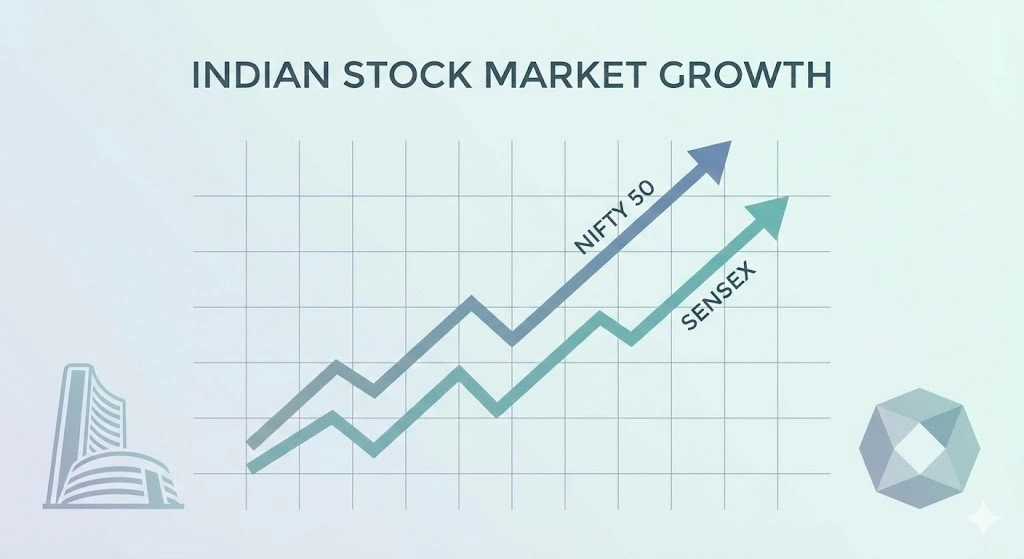
When I stepped into the stock market arena, I saw names like "Nifty," "Sensex," "Dow Jones," "S&P 500" everywhere, and the stock prices were going up and down. The news channels were full of excitement, and everyone on the street was talking about "the index is up today." It was at this point that I realized something important:
 "To know the individual stocks, the individual must first know the indexes."
This guide explains stock market indexes from basics to advance levels, using simple examples to help you understand how indexes work and why they matter.
What Are Indexes in the Stock Market?
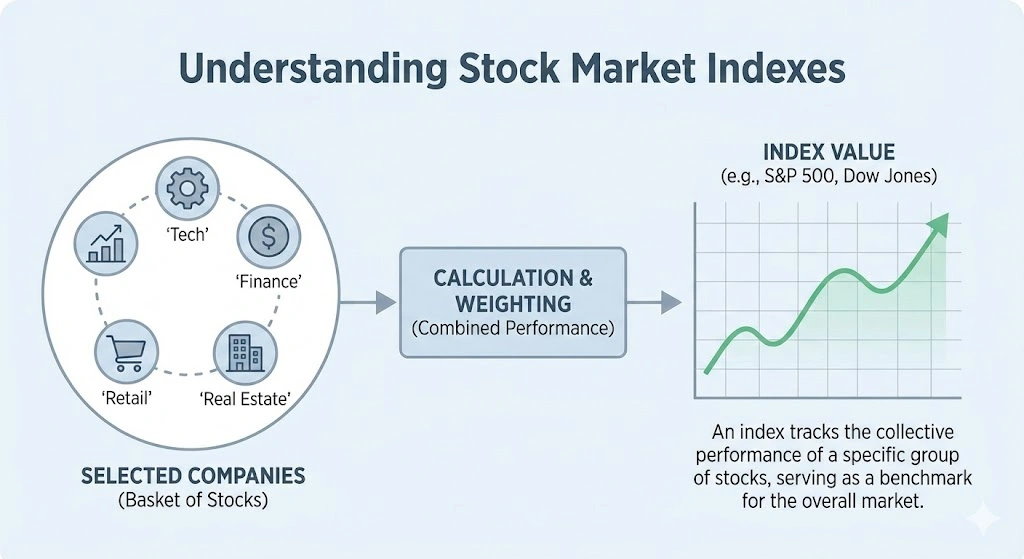
Indexes are summary measures representing the general market performance of a group of stocks. Contrary to an individual company, Indexes track a group of companies.
In other words, an index is a sort of report card for the market or a sector.
If the companies are performing well, the index goes up. Similarly, if the companies are performing poorly, the index will go down.
Why Indexes exist?
Indexes are created to ease the stock market.
Instead of focusing on a variety of stocks, investors use the data provided by “Indexes” to gauge the market’s direction.
They help solve questions such as:
- What is the state of the market: bullish or bearish?
- Are large companies doing well?
- Is the sector growing or slowing down?
Real World Example of Indexes
Consider your cricket team scorecard.
Individual performers are important, but the team score determines who wins.
Likewise, stocks are important, yet the overall picture of the market’s performance is represented by the Indexes
Popular Indexes in India
Some well-known Indexes in India include:
- Nifty 50
- Sensex
- Bank Nifty
- Nifty IT
Each index contains a different group of companies.
Popular Global Indexes
Global “indexes” include:
- S&P 500
- Dow Jones
- Nasdaq
- FTSE 100
- These countries represent key economies and markets.
How Indexes Are Created
The selection rules form the basis for the creation of indexes.
The selection of companies is based on:
- Market capitalization
- Liquidity
Beginning set of features consists of the following: - Trading volume
- Sector representation
This keeps Indexes balanced and reliable.
This means that by analyzing rapid changes in the price of goods, one can trace backward to determine what caused those price changes.
Market Capitalization and Indexes
Most of the Indexes are market-cap weighted.
Large companies tend to have more impact.
The more the company that moves, the more the index is going to move.
Price Weighted Indexes
Some Indexes are price weighted.
The higher-priced stocks tend to drive the index more. This method is less in use today.
Free Float Method in Indexes
Free float only includes shares traded publicly.
Shares held by the promoter are excluded.
This presents a more realistic view of market movements.
Sectoral Indexes Explained
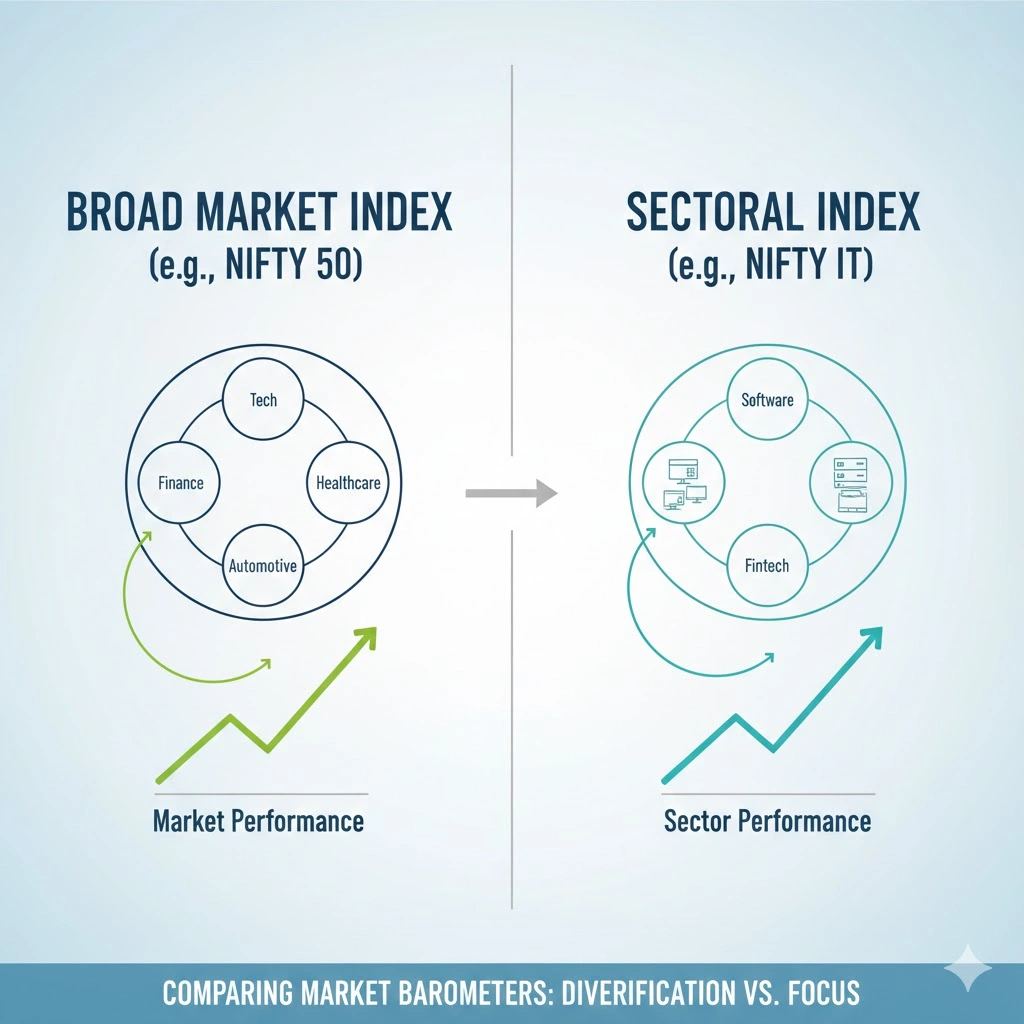
Sectoral Indexes track the sectors.
Examples:
- Banking index
- IT index
- Pharma index
They enable the analysis of the performance of the sectors by the
Broad Market Indexes
Broad market Indexes are quite comprehensive.
They are a reflection of the economy.
Some examples are Nifty 50 and Sensex.
Index Movement Explained
Instead of moving directly because of changes in stock price, indexes do move
Good news causes stocks to rise.
Negative news has a tendency to move the indexes down
Market sentiment makes a big difference.
Indexes and Economic Health
Indexes are economic mirrors.
“Increasing Indexes shows growth.”
“Falling Indexes signal caution”
Governments and institutions monitor them.
How Investors Use Indexes
Investors use Indexes to:
- Understand market trend
- Compare portfolio performance
- Decide asset allocation
Indexes guide long-term decisions.
Index Funds Explained
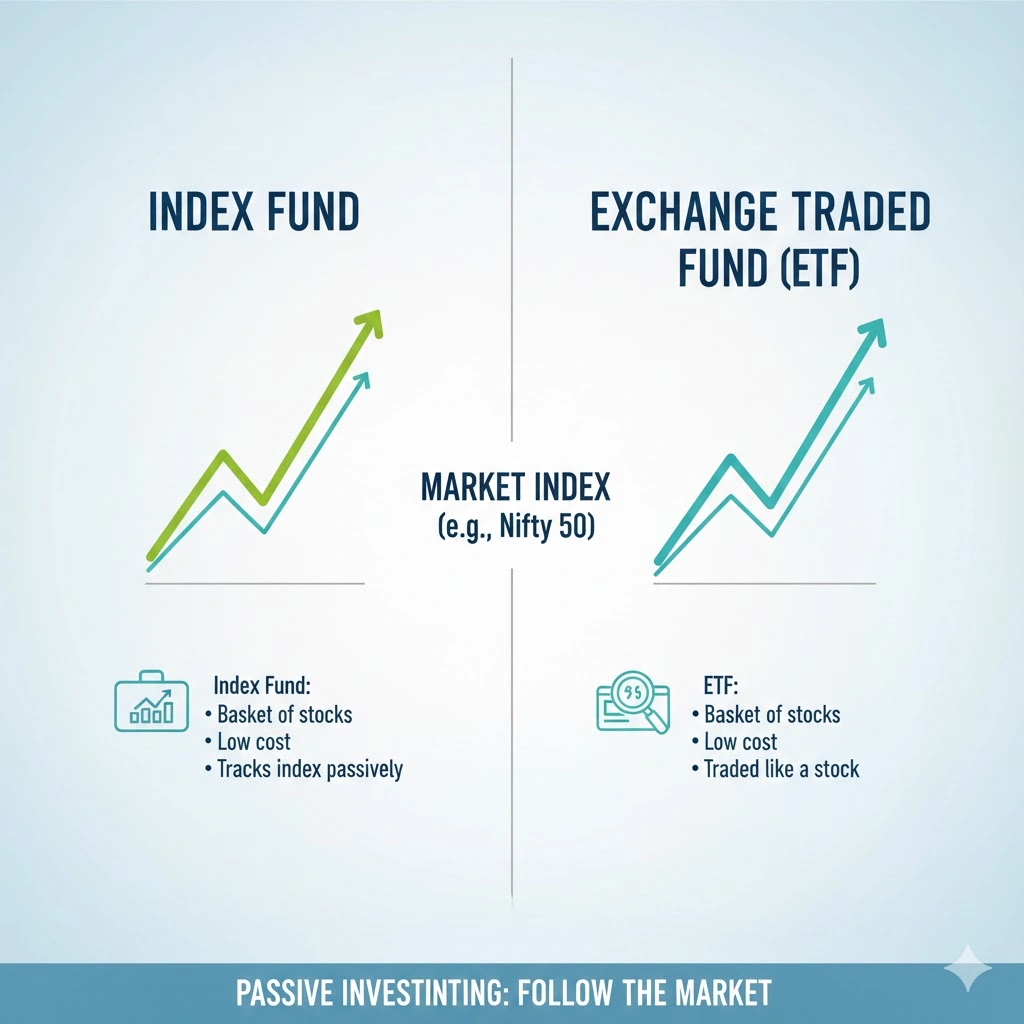
Index funds track Indexes.
They invest in the same stocks.
Costs are low.
Returns mirror the index.
ETFs and Indexes
ETFs also track “indexes”.
They are bought and sold like stocks.
Offers Flexibility and Diversification
learn how ETFs work in detail
Indexes vs Individual Stocks
Indexes help to reduce risk
Stocks promise higher return costs.
Balanced investors use both.
Indexes and Passive Investing
Passive investing utilizes Indexes.
No stock picking.
Long-term focus.
Discipline is more important than timing.
Can Indexes Be Manipulated?
There are rules that govern indexes
Manipulation is a difficult practice
Transparency retains integrity.
Common Myths About Indexes
- Index investing is boring
- Indexes offer low returns
- Indexes are used only for beginners
These are misconceptions.
Indexes in Market Crashes
Indexes fall in crashes.
They also heal/repair over time.
Patience is rewarded for investors
Long-Term Performance of Indexes
In the past, Indexes are enlarging
They indicate economic development.
Time in market matters.
Advanced View on Indexes
Advanced investors study the composition of the index.
They are concerned with weight changes.
They track rebalancing effects.
Index Rebalancing Explained
Indexes are periodically reviewed.
Companies can be added or removed.
This will keep the indexes updated.
Indexes and Wealth Building
Indexes enable sustained wealth creation.
They minimize emotional trading.
The key is consistency.
Final Verdict
Knowing what Indexes are would make investing simple.
They bring clarity.
They guide decisions. Indexes are the heartbeat of the stock market.
FAQs
1. Are indexes safe to invest in?
- Risk exists
- Whereas, Long-term horizon reduces risk
2. Can beginners invest in indexes?
- Yes, Index Funds are Friendly to Beginners
3. Do indexes ensure return?
- No, Markets entail risks
4. How frequently are indexes updated?
- Periodically, Rule-based
5. Are indexes better than stocks?
- Depends on goals The balance is optimum.